The debate over whether Zenyatta is the greatest horse ever will, frankly, never be settled. If she wins the Breeders' Cup Classic, it's hard to argue against her, but people will. She can't race against the greats of the past.
Or can she?
The NTRA has produced a race simulation pitting Zenyatta against some of the great horses in racing history - Citation, Affirmed, Rachel Alexandra and others.
You can watch the virtual race below. Secretariat is notably absent. I assume he was a late scratch OR the result was specifically designed as a Zenyatta promotion. Decide for yourself. I'm as big a Z fan as there is, and she has won every race when certain other greats lost races (sometimes more than one), but this may border on suspicious.
No matter. It's just kind of fun to watch:

Saturday, October 30, 2010


So You Think you know racing

Well, the probable favorite for the Melbourne Cup just won a race today, and he's running in Australia's biggest race on Tuesday.
So You Think won a top level stakes, the Group 1 Mackinnon on Saturday at 2,000 meters (1.2 miles), and he'll run in the $6 million Melbourne Cup at 3,200 meters on Tuesday.
So You Think has won 8 of 11 career starts, so he's clearly a superhorse. But he gives new meaning to superhorse if he pulls off a win after only two days rest against a field of 18 other top horses.
I suppose it's a cultural thing. It used to be in this country that horses ran a lot more often. Not that long ago, people wouldn't bat an eye at a horse running back in a week. Today in the US, at least at the highest levels of competition, a minimum of three weeks is usually required and sometimes quite a bit more.
So when I read that So You Think raced today, I was like, WHAT? I thought it was a mistake, a misprint, an April Fools joke, since it's Spring in Australia.
But no, it's just a finely-tuned beast on top of his game, and connections that have no fear.
I love it.
Of course, the welfare of the horse is always the top priority, but owners and trainers in this country are far too conservative about what their athletes can do. Exhibit A: The controversy over Rachel Alexandra and Zenyatta. Rachel retires after a fantastic work. Zenyatta's connections are accused of "dodging" certain competition.
I have nothing but the utmost respect for Zenyatta and her handlers. She has stayed sound and healthy and has won every race in her career. What more is there?
But there's a different kind of respect for teams that aggressively place their horses and trust their athletic ability. Yes, Thoroughbreds are fragile, but they have also proven to be amazingly resilient. If you have horse, let him (or her) run.
And if you have a horse that likes win, by all means put them on the track every chance you get.
So I Think.
Sunday, October 10, 2010
When you know, you know
There are so few times in horse racing that you genuinely know what's about to happen, that it is absolutely essential that you take advantage when you do know.
Case in point -- Sunday's 6th race at Keeneland. I was privy to a conversation on the backside at Churchill Downs that involved one of the horses in that race. I was told that Dancinginherdreams, trained by John Ward, was an extremely fast two-year-old filly making her first-ever start. The sense I got from the conversation was that this filly was ready to win first out and then some.
Well, she did -- in spectacular fashion. Dancinginherdreams checked badly on the backstretch, closed from last in a field of 12, circled widest of all for the entire race and still won easily by open lengths, under a hand ride by Julien Leparoux. I dare you to find a better maiden victory first-time-out than that.
Yeah, I made a few sheckles on the deal, but since I'm not one to bet first-time starters very often, I didn't clean up like I should have.
Part of the problem was that, obviously, the word got out within the racing circle, that this filly was something special. She was bet down from 10-1 morning line to 3-2 at post time.
But I've seen plenty of high morning lines get bet down to low odds and finish up the track.
The difference, in this case, was that I knew she was something special. It's not like I was watching TVG and heard someone make a random comment. I had actual first-hand knowledge about this filly.
I guess since I've chosen to immerse myself in racing as a new career, I should start taking this information a bit more seriously. Had I considered this situation a stone-cold lock, I would've done a lot better.
Of course, nothing is a stone-cold lock in this sport, but if you can get close to it, opportunity goes begging if you don't pounce.
There was another case last week of a colt I had seen work out at Churchill, and I knew because of the race he was entering, he should win easily. Again, because of my background as a racing fan but not an "insider," I went light in my betting. He won by eight lengths with the greatest of ease at 5-2, a ridiculous price in hindsight.
While it may seem frustrating, it's also encouraging that I'm two-for-two with something resembling inside information.
I suppose the point is that if you genuinely know something, you know it. You don't even have to have inside info. You just have to have a logical explanation, based on valid evidence. Even before I arrived here, there were plenty of cases where I had no inside information but had picked up on something legitimate and it proved to be correct, after putting in the work to figure it out. An example is the turf course bias at Gulfstream over the winter, which I'll be happy to explain if you're interested.
Conversely, if you think you know something but in your mind, you actually know you're just guessing, the gods will sort you out and punish you with a vengeance. I have met the devil at the crossroads many times by hoping shortcuts will work.
They never do.
Figuring out the difference is the key to being successful in this game.
As for Dancinginherdreams, she should absolutely run in the Breeders' Cup Juvenile Fillies if at all possible. Her maiden win was so impressive, I won't be the least surprised if she wins the thing.
But now, everyone else knows exactly what I know.
Case in point -- Sunday's 6th race at Keeneland. I was privy to a conversation on the backside at Churchill Downs that involved one of the horses in that race. I was told that Dancinginherdreams, trained by John Ward, was an extremely fast two-year-old filly making her first-ever start. The sense I got from the conversation was that this filly was ready to win first out and then some.
Well, she did -- in spectacular fashion. Dancinginherdreams checked badly on the backstretch, closed from last in a field of 12, circled widest of all for the entire race and still won easily by open lengths, under a hand ride by Julien Leparoux. I dare you to find a better maiden victory first-time-out than that.
Yeah, I made a few sheckles on the deal, but since I'm not one to bet first-time starters very often, I didn't clean up like I should have.
Part of the problem was that, obviously, the word got out within the racing circle, that this filly was something special. She was bet down from 10-1 morning line to 3-2 at post time.
But I've seen plenty of high morning lines get bet down to low odds and finish up the track.
The difference, in this case, was that I knew she was something special. It's not like I was watching TVG and heard someone make a random comment. I had actual first-hand knowledge about this filly.
I guess since I've chosen to immerse myself in racing as a new career, I should start taking this information a bit more seriously. Had I considered this situation a stone-cold lock, I would've done a lot better.
Of course, nothing is a stone-cold lock in this sport, but if you can get close to it, opportunity goes begging if you don't pounce.
There was another case last week of a colt I had seen work out at Churchill, and I knew because of the race he was entering, he should win easily. Again, because of my background as a racing fan but not an "insider," I went light in my betting. He won by eight lengths with the greatest of ease at 5-2, a ridiculous price in hindsight.
While it may seem frustrating, it's also encouraging that I'm two-for-two with something resembling inside information.
I suppose the point is that if you genuinely know something, you know it. You don't even have to have inside info. You just have to have a logical explanation, based on valid evidence. Even before I arrived here, there were plenty of cases where I had no inside information but had picked up on something legitimate and it proved to be correct, after putting in the work to figure it out. An example is the turf course bias at Gulfstream over the winter, which I'll be happy to explain if you're interested.
Conversely, if you think you know something but in your mind, you actually know you're just guessing, the gods will sort you out and punish you with a vengeance. I have met the devil at the crossroads many times by hoping shortcuts will work.
They never do.
Figuring out the difference is the key to being successful in this game.
As for Dancinginherdreams, she should absolutely run in the Breeders' Cup Juvenile Fillies if at all possible. Her maiden win was so impressive, I won't be the least surprised if she wins the thing.
But now, everyone else knows exactly what I know.
Saturday, October 9, 2010
A horse lover's dream day
What could be better than opening day at Keeneland, with a dash of World Equestrian Games and a sprinkling of morning workouts with the Kentucky Derby winning jockey?
Such was my Friday:
6:00 a.m. Pick up my buddy from the Equine Business program at the University of Louisville.
6:15 a.m. Arrive on the backside at Churchill Downs and visit with the trainer my friend is working for.
6:25 a.m. Shake hands with jockey Calvin Borel, winner of the last two Kentucky Derbies. He's working one of the trainer's horses. Conversation:
"Hi, Calvin, nice to meet you.
"Good to meet you, Scott. Whew, whee, we almost didn't make it! There was a plane landed on the freeway!
"Oh yeah, I heard about that."
"Yeah, we were driving in and I look over and there's a plane! Man, I said, there's a plane on the freeway! Can you believe that? A plane on the freeway! I was like, whaaaat?
"Oh yeah?"
"Yeah, whew-whee, boy, I wasn't sure we were going to make it on time! Geeeee!"
The point being, Calvin is exactly the person you see on television. It was 6:30 in the morning, and he was jacked up 100% Cajun. What a character.
6:35 a.m. 5 furlong workout complete - very nice three-year-old, going easy, wrapped up by Calvin, lots in the tank.
7:15 a.m. Breakfast at a hard-core diner. Friendliest waitress in the world.
8:15 a.m. Pick up Daily Racing Form for Keeneland at the pharmacy across from Churchill Downs. Head to Lexington.
10:00 a.m. Arrive at Kentucky Horse Park for the World Equestrian Games.
 10:30 a.m. Watch acrobats perform "vaulting" on the back of a draft horse. See photo above.
10:45 a.m. Sit in the stands for a game of "Horse-Ball," which is best described as basketball on horseback. In fact, it is exactly like basketball on horseback. I saw a female rider "box out" a male rider with elbows and then swish one in the basket!

These riders have incredible balance and agility. See what happens when the "Sputnik"-looking ball almost hits the ground:

11:00 a.m. Watch Standardbreds, Hackneys and Irish Connemara ponies perform. All of these horses are gorgeous in their own way.

There are few things more beautiful than a horse in full flight:

11:30 a.m. Catch shuttle to our parking space 2 miles from the Games (which cost $20). Ouch.
12:30 p.m. Arrive at Keeneland race course, where the parking is free and the racing always fantastic.

Keeneland is special because the racing facilities are stunning, probably the nicest in the country. The backdrop isn't as breathtaking as Santa Anita's mountains (here, it's just horse pastures for miles), but I daresay the paddock is the most gorgeous you'll find just about anywhere:
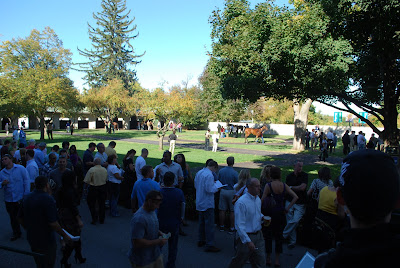

That's Michelle Yu from TVG there on the right of the bottom photo. We also chatted with long-time TV handicapper Hank Goldberg for a bit.
4:15 p.m. Paracaidas wins a one-mile turf allowance with ease, Garrett Gomez on board:

5:20 p.m. Wickedly Perfect takes the Grade 1, Alcibiades Stakes for two-year-old fillies in impressive fashion, completing a nice double for my buddy. He was all over Wise Dan upsetting Hollywood Hit in the previous race. I thought Hollywood Hit was a cinch. I made up for it by hitting a $55 exacta earlier in the card.
No matter. I could've lost all day, and it still would've ranked as one of my favorite days of all time.
8 p.m. Arrive back home in Louisville, delightfully exhausted.
Such was my Friday:
6:00 a.m. Pick up my buddy from the Equine Business program at the University of Louisville.
6:15 a.m. Arrive on the backside at Churchill Downs and visit with the trainer my friend is working for.
6:25 a.m. Shake hands with jockey Calvin Borel, winner of the last two Kentucky Derbies. He's working one of the trainer's horses. Conversation:
"Hi, Calvin, nice to meet you.
"Good to meet you, Scott. Whew, whee, we almost didn't make it! There was a plane landed on the freeway!
"Oh yeah, I heard about that."
"Yeah, we were driving in and I look over and there's a plane! Man, I said, there's a plane on the freeway! Can you believe that? A plane on the freeway! I was like, whaaaat?
"Oh yeah?"
"Yeah, whew-whee, boy, I wasn't sure we were going to make it on time! Geeeee!"
The point being, Calvin is exactly the person you see on television. It was 6:30 in the morning, and he was jacked up 100% Cajun. What a character.
6:35 a.m. 5 furlong workout complete - very nice three-year-old, going easy, wrapped up by Calvin, lots in the tank.
7:15 a.m. Breakfast at a hard-core diner. Friendliest waitress in the world.
8:15 a.m. Pick up Daily Racing Form for Keeneland at the pharmacy across from Churchill Downs. Head to Lexington.
10:00 a.m. Arrive at Kentucky Horse Park for the World Equestrian Games.

10:45 a.m. Sit in the stands for a game of "Horse-Ball," which is best described as basketball on horseback. In fact, it is exactly like basketball on horseback. I saw a female rider "box out" a male rider with elbows and then swish one in the basket!

These riders have incredible balance and agility. See what happens when the "Sputnik"-looking ball almost hits the ground:

11:00 a.m. Watch Standardbreds, Hackneys and Irish Connemara ponies perform. All of these horses are gorgeous in their own way.

There are few things more beautiful than a horse in full flight:

11:30 a.m. Catch shuttle to our parking space 2 miles from the Games (which cost $20). Ouch.
12:30 p.m. Arrive at Keeneland race course, where the parking is free and the racing always fantastic.

Keeneland is special because the racing facilities are stunning, probably the nicest in the country. The backdrop isn't as breathtaking as Santa Anita's mountains (here, it's just horse pastures for miles), but I daresay the paddock is the most gorgeous you'll find just about anywhere:


That's Michelle Yu from TVG there on the right of the bottom photo. We also chatted with long-time TV handicapper Hank Goldberg for a bit.
4:15 p.m. Paracaidas wins a one-mile turf allowance with ease, Garrett Gomez on board:

5:20 p.m. Wickedly Perfect takes the Grade 1, Alcibiades Stakes for two-year-old fillies in impressive fashion, completing a nice double for my buddy. He was all over Wise Dan upsetting Hollywood Hit in the previous race. I thought Hollywood Hit was a cinch. I made up for it by hitting a $55 exacta earlier in the card.
No matter. I could've lost all day, and it still would've ranked as one of my favorite days of all time.
8 p.m. Arrive back home in Louisville, delightfully exhausted.
Sunday, October 3, 2010
More of this please...
The stars are aligning for this year's Breeders' Cup - hopefully the people running the show realize the golden opportunity in front of them, between the movie, Secretariat, and the real-life racing star who is doing a mighty good impression of Big Red.
From the video below, it appears that perhaps they do. The promo popped up on YouTube last night after Zenyatta's thrilling victory in the Lady's Secret stakes, her 19th win in a row. The final race of her career will be one of the biggest races in the world, the Breeders' Cup Classic November 6th at Churchill Downs, where she will try to end her career a perfect 20 for 20.
Astonishing.
If you missed the Lady's Secret, that's posted below as well. When I bet on a race, I always get a little adrenaline rush as the horses approach the wire, maybe a few fast beats of the heart, if my horse is involved.
I didn't have a dime on Zenyatta's race, and my heart was pounding out of my chest right before she hit the line in her usual oh-my-god-I-don't-think-she's-going-make-it-this-time!!! fashion.
She's in a class all by herself as a champion racehorse.
I love her. I will miss her. I have run out of words to describe her. Let's just roll the videos:
From the video below, it appears that perhaps they do. The promo popped up on YouTube last night after Zenyatta's thrilling victory in the Lady's Secret stakes, her 19th win in a row. The final race of her career will be one of the biggest races in the world, the Breeders' Cup Classic November 6th at Churchill Downs, where she will try to end her career a perfect 20 for 20.
Astonishing.
If you missed the Lady's Secret, that's posted below as well. When I bet on a race, I always get a little adrenaline rush as the horses approach the wire, maybe a few fast beats of the heart, if my horse is involved.
I didn't have a dime on Zenyatta's race, and my heart was pounding out of my chest right before she hit the line in her usual oh-my-god-I-don't-think-she's-going-make-it-this-time!!! fashion.
She's in a class all by herself as a champion racehorse.
I love her. I will miss her. I have run out of words to describe her. Let's just roll the videos:
Friday, September 24, 2010
Keeneland Sales Update
Earlier this week, I suggested a different way to look at the Keeneland yearling sales numbers. This is a follow-up to that post.
My equine finance professor at the University of Louisville, along with a fellow student, compared the sales results from 2009 to 2010 by using the percentage of horses offered instead of comparing day 1 to day 1, day 2 to day 2, etc as most people have been doing. Since Keeneland changed its format this year, the percentage method makes more sense. Here's an update on how the sale is progressing:
Update on Keeneland Sale Averages from Kate Ellis and Robert Losey
Scott Jagow was kind enough to let us use his blog as a sounding board on Sept. 21, where we argued that the cumulative averages for the September Keeneland Sale were overestimating what is really happening. We also predicted that the cumulative averages reported in the media would appear to drop substantially each day because of the unrealistic comparisons that result when session by session comparisons are made instead of comparing similar segments by percentage completion of the sales. We expect that when the sale is completed, the cumulative average (both ours and the reported in the media) will be up by 1-3%. If we’re right, this suggests two things: 1) the market may have bottomed out and is hopefully starting to turn up (we predict an increase in the November Sale averages because of diminished supply effects), and 2) there is a better way to compare sales from one year to the next than what the media has been reporting.
The first two columns below report our calculations for the sale. In the last column we provide the media calculation of the cumulative average as reported for days 9-11.
Sale Change Ellis/Losey Media
From Comp Calculation Calculation
In 2009 of Cumulative of Cumulative
Day Change Change
1 +49% +49%
2 +44% +46%
3 -41% -6%
4 - 7% -6%
5 +18% -2%
6 +39% +3%
7 +2% +2%
8 +29 +4%
9 -27% +2% +24.3%
10 +1% +2% +12.3%
11 -10% +2% + 9.9%
Note that the first two sessions appear to be anomalies, and they are. This is the first time that Keeneland has used night sessions for days 1 and 2, and the “super select” nature of the first two sessions resulted in a skyrocketing average for those sessions. The third session drastic drop off is also predictable. Keeneland attempted to equalize the quality of yearlings for sessions 3 through 7 this year, while in 2009 session 3 was probably the third best group of yearlings. Thus the comparisons of sessions 3 and 4 this year suffered, while the comparisons of session s 5 and 6 this year were favorable relative to similar segments last year.
Wednesday, September 22, 2010
An ode to Presious Passion
Most racehorses only shine for a short period of time. That's just the way it is in racing. Better enjoy it while it lasts.
Presious Passion is one of those horses that sparkled brilliantly, and now, may only leave memories in his wake.
Less than a year ago, Presious Passion nearly beat one of the best turf horses in the world in one of the biggest turf races in the world. The Breeders' Cup Turf is a $3 million, Grade 1 race of the highest order. At long odds, Presious Passion lost by half a length. He ran his guts out, as he always does.
But today, 10 months later, he ran in a $65,000 N2Y optional claiming race on a Wednesday afternoon at Delaware Park. He finished a well-beaten fourth.
At first, I was simply sad. Sad that this once bright star was clearly fading. But that is hardly the way to remember Presious Passion.
Those who follow racing closely know Passion well. He is the Steve Prefontaine of the thoroughbred world. Prefontaine was a brilliant long-distance runner whose own star faded way too soon (he was killed in a car crash). Prefontaine was renowned for his theory that running a race was a work of art. He believed the only way to run long distances was to go flat out as fast as you can until you have nothing left. To him, winning any other way -- like drafting on his opponents -- was chickenshit.
 Pre would've loved Presious Passion. Look at him in the Grade 1 United Nations, opening up 20 lengths in the first half of the race. That's him waaaaay out in front. You see that time, 45.1, in the upper corner? That would be a scorching time in a race threefold shorter than this! 99% of racehorses could never survive that pace.
Presious Passion won. He won quite often this way, screaming to the lead in a fashion that would be a suicide mission for most horses.
Like Pre, Presious Passion only knew one way to go -- flat out, in front, until he had nothing left.
In another race, Presious Passion opened up a huge lead and then was passed in the stretch, seemingly done. But he fought back, and just feet from the wire, he rallied past what looked to be the winner. That rarely happens in racing. Once a horse is passed in the stretch, he's usually finished. Presious Passion simply would not quit. It was an amazing moment.
Today, in a much lesser race, I saw a spark of the old Presious Passion. He was passed in the stretch, and once again, he tried to re-rally . If you paid attention, you could see his will to win. He was clearly saying, I am still all heart. His body just wouldn't cooperate.
All of this sounds like an obituary for Presious Passion's career. Perhaps the race he ran today was too short. He seems to excel at distances beyond today's 1 1/16 miles. Maybe he'll re-rally again. But more likely, at age 7, Passion's extraordinary days are behind him.
I, for one, am glad to have witnessed his greatness. Here's a toast to Pre-sious Passion:
Presious Passion is one of those horses that sparkled brilliantly, and now, may only leave memories in his wake.
Less than a year ago, Presious Passion nearly beat one of the best turf horses in the world in one of the biggest turf races in the world. The Breeders' Cup Turf is a $3 million, Grade 1 race of the highest order. At long odds, Presious Passion lost by half a length. He ran his guts out, as he always does.
But today, 10 months later, he ran in a $65,000 N2Y optional claiming race on a Wednesday afternoon at Delaware Park. He finished a well-beaten fourth.
At first, I was simply sad. Sad that this once bright star was clearly fading. But that is hardly the way to remember Presious Passion.
Those who follow racing closely know Passion well. He is the Steve Prefontaine of the thoroughbred world. Prefontaine was a brilliant long-distance runner whose own star faded way too soon (he was killed in a car crash). Prefontaine was renowned for his theory that running a race was a work of art. He believed the only way to run long distances was to go flat out as fast as you can until you have nothing left. To him, winning any other way -- like drafting on his opponents -- was chickenshit.

Presious Passion won. He won quite often this way, screaming to the lead in a fashion that would be a suicide mission for most horses.
Like Pre, Presious Passion only knew one way to go -- flat out, in front, until he had nothing left.
In another race, Presious Passion opened up a huge lead and then was passed in the stretch, seemingly done. But he fought back, and just feet from the wire, he rallied past what looked to be the winner. That rarely happens in racing. Once a horse is passed in the stretch, he's usually finished. Presious Passion simply would not quit. It was an amazing moment.
Today, in a much lesser race, I saw a spark of the old Presious Passion. He was passed in the stretch, and once again, he tried to re-rally . If you paid attention, you could see his will to win. He was clearly saying, I am still all heart. His body just wouldn't cooperate.
All of this sounds like an obituary for Presious Passion's career. Perhaps the race he ran today was too short. He seems to excel at distances beyond today's 1 1/16 miles. Maybe he'll re-rally again. But more likely, at age 7, Passion's extraordinary days are behind him.
I, for one, am glad to have witnessed his greatness. Here's a toast to Pre-sious Passion:
Tuesday, September 21, 2010
A horse of a different statistical color

It's heartening to hear these numbers, since we all want to see the racing industry bounce back from the recent crushing economic blows. But are the numbers accurate?
It's fair to question them since Keeneland changed its sales format this year but hasn't changed its method of comparison -- that is, for example, comparing Day 1, 2009 to Day 1, 2010. If there are fewer horses being offered the first two days of the sale this year, it seems there should be an adjustment in the way the two years are compared.
We've been talking about this quite a bit in my equine finance course at the University of Louisville, and our professor has come up with an alternative method. He's comparing the sales in terms of percentage of horses catalogued. It makes sense.
I can't say with 100% certainty that his method is without flaw or that the numbers are 100% accurate (although I'm confident that they are), but it gives us a different way to measure the Keeneland sale in any case. It's important to look at these things with a healthy dose of realism, even though we might want to see eye-popping numbers. So, without further adieu, here's professor Robert Losey's explanation:
Keeneland September Sales Results: Are They Really Up That Much?
Making sense of what is happening to prices at the Keeneland September sale is especially difficult in 2010. There have always been problems in comparing one year to the next: One complication relates to the length of sales. In 2008 Keeneland September had 15 sale sessions: In September 2009 it had only 14. Reports we have seen compared the first day 2009 to the first day 2008 and continued the comparison out until they compared the 14th (which was the final) day 2009 to the 14th day 2008. This left the 15th (final) day 2008 in a state of limbo where it was not compared to anything. More reasonably, it would have made sense to compare the two final days (14th day 2009 and 15th day 2008) to each other, as each had similar quality horses.
This year, comparisons have become much more difficult because of Keeneland’s new format. Should the 105 horses from day 1 2010 be compared to the 207 horses offered on day 1 last year? Should day 6 this year, which is still part of the select portion of the sale, be compared to last year’s non-select day 6, or to day 4 in 2009, the final select day last year?
Kate Ellis, an equine certificate student in the Equine Industry Program at the University of Louisville, working with Robert Losey, Professor of Equine Management, has devised a statistical “fix” that makes comparisons of sale averages from one year to the next more logical. Rather than report day by day comparisons, the Ellis approach compares the day 1 sales this year (which made up the first 2.16% of the total yearlings offered) to the sales average for the first 2.16% of horses from last year’s sale. Subsequent comparisons follow similar lines, always comparing horses offered in comparable percentage segments of each year’s sale. This approach has the salutary effect that it is more likely to compare horses of similar quality: Early-sale horses are compared, mid-sale horses are compared, and end-of-sale horses are compared.
Because of the change in the format for the 2010 sale, which featured very small first and second-day “super-select” yearlings, our method, though an improvement over what is typically being reported, still provides an apples-to-cranapples comparison on a day-by-day basis for the first six sessions for 2010. However, with the completion of the sixth session of Keeneland on Friday, our method provides an apples-to-apples comparison for the cumulative average starting with day 6 and for each subsequent session. Going forward our method also provides a useful basis for comparing each 2010 sale day to a comparable segment of last year’s sale.
Compare our method to reports from other sources. For the second Monday (Sept. 20, 2010), other sources compared this session, which was the eighth session, but the second non-select session in 2010, to the eighth session 2009, which was the fourth non-select session in 2009. Not surprisingly, because Keeneland tries to place yearlings with the highest values early in a sale, the 2010 eighth session, which was substantially earlier in the sale relative to the 2009 eighth session based on the fraction of horses offered, generated much higher sales prices.
The eighth session in 2010 offered yearlings that fell into the range between the first 24.4% of horses offered and those following the first 31.2%.
Results from the first six segment-to-segment comparisons (based on percentage completion of each sale) are not surprising. The two night “super-select” 2010 sessions outdid comparisons to last year. The four-day select sessions that followed the night sessions started off looking weak, but only because this year’s sessions 3-6 represented similar quality horses, while last year’s sessions started with the higher quality yearlings and proceeded down the quality ladder each day. Comparisons of 2010 (Sunday) session 7 with yearlings from comparable segments of the 2009 sale showed a slight gain. Our reported gain of 2.4% compares to the reported gain of “almost 50%” generally reported by other sources for session 7.
Results from the first six segment-to-segment comparisons (based on percentage completion of each sale) are not surprising. The two night “super-select” 2010 sessions outdid comparisons to last year. The four-day select sessions that followed the night sessions started off looking weak, but only because this year’s sessions 3-6 represented similar quality horses, while last year’s sessions started with the higher quality yearlings and proceeded down the quality ladder each day. Comparisons of 2010 (Sunday) session 7 with yearlings from comparable segments of the 2009 sale showed a slight gain. Our reported gain of 2.4% compares to the reported gain of “almost 50%” generally reported by other sources for session 7.
Comparisons of the cumulative averages using our methodology yield a similar story. Most media outlets reported that the cumulative average was up approximately 18% through Sunday. Using our approach we calculate an increase of 4.1% through that session. We have extrapolated what the reports from the media are likely to look like for ensuing days. Using the session-to-session comparisons reported in most of the media, the reported cumulative averages will continue to overestimate the cumulative average each day, but by a lesser amount each day. If the favorable numbers we see for the eighth session continue, the final cumulative average will be up, but by single digits, probably closer to 5% than to 10%, and not by the double digit numbers that current media reports might seem to indicate.
Though we would have preferred to have seen double-digit increases, we would view a 5% increase as indicative that the market has bottomed. We would expect that the November sale, which will sell mares from a significantly smaller supply of mares that were bred in 2010, will show increased average prices over 2009.
Sunday, September 19, 2010
At the Keeneland sale

I thought I'd share my experience at the Keeneland auction this week, as I got to go behind the scenes.
Most of my experiences in racing so far have revolved around the track. But these sales are where the race horses of tomorrow are bought and sold, and it definitely gave me a different perspective on the world of racing.
A lot of the big-name trainers were there, looking for that next Kentucky Derby horse. Nick Zito, Bob Baffert. I was standing near Baffert as he inspected hip # 1368, a yearling sired by Ghostzapper, a phenomenal runner in his day. These one-year-olds haven't been named yet, so they're just a number at the sale. In this case, a number with a pretty nice pedigree -- a Ghostzapper colt out of a Skip Trial mare.
A fellow student in the equine business program at the University of Louisville tapped me on the shoulder and asked, "How much you think that horse will go for?" I had no idea, and in fact, I've learned that even the most astute observers sometimes have no idea. But I figured if Baffert was looking at him, I probably couldn't mortgage every house I've ever owned and still be in the bidding. We followed hip #1368 into the auction ring. Baffert did not come with him.
A few minutes later, the announcer described hip #1368, and the strapping colt strode into the sales arena. No one in the audience said anything, but I'm pretty sure there were internal "ooohs and aaahhs."
"Hey-diggity-digg-diggity-digg-diggity-digg-10-hey-diggity-digg-diggity-digg-20."
That's the only way I know how to describe the auctioneer's call. For six hours a day, that's all you hear all over the Keeneland grounds.
"Hey-diggity-digg-diggity-digg-30-hey-diggity-digg-diggity-diggity-digg-40. Or better yet, listen for yourself:
While the speaking in tongues continued, in the audience, everyone was stone-faced. It was nearly impossible to know who was bidding and making the diggity-diggs become actual numbers. After a few sales, I started to spot the bidders -- people wearing baseball caps who were giving signs like catchers to their pitchers. A little swipe of the nose here, a two fingered-salute there, and yes, the price just went up!
A couple seats away from me was a man in a baseball cap on a cell phone. I had seen him talking to Baffert earlier. I listened intently as the guy repeated the bidding prices into the phone. I assumed Baffert was on the other end, and he definitely seemed in the game for hip # 1368.
The bid spotter kept looking at the guy and giving him hand signals, asking without asking, "you in for $250,000? $300,000? The guy in the baseball cap ever-so-slightly nodded as the price went up and up and up. And finally, after a couple minutes of this, the diggity-diggs ended with the words: "SOLD, for $500,000!"
That's life at the world's premiere yearling auction. Two minutes, $500,000.

We went to the barns and looked at the conformation of various horses that were about to be sold. As a racing fan, I'm sure I'm not alone as someone who doesn't really know what to look for. Did you see that horse's overstride? Watch where the front hoof lands and make sure that the back hoof hits that mark or exceeds it. That's a good sign. Are the limbs too close together? Bad sign. Is the pastern at the right angle so that it can cushion the impact of running?
Fascinating.
These are some of the components of finding a winning racehorse. Those who've been around horses for many years know this stuff by heart, but for others, it's a whole new world. I'm one of those people. And that's why I'm here.
I have a fairly good sense of pedigrees, but when it comes to physical issues, that's where I'm still a novice, and just spending a day at Keeneland was a fantastic education. A guy like Baffert, with his experience and keen eye, can spot a nice one, no matter the price. Me and my buddy, we were about ready to split a $10,000 Theatrical colt. I swear he had a great turf pedigree, but no one seemed to care. The price didn't budge from $10,000, and that is nothing when it comes to buying Thoroughbreds.
The thing is, you just never know. A couple years from now, I could see that colt striding home to victory in the Breeders' Cup turf sprint. Baffert's horse may never even make it to the track.
If he does, at $500,000, he better win a few races.
Saturday, September 11, 2010
It's that time of year

As part of my studies with the Equine Business program at the University of Louisville, we'll be driving down to Lexington later this week to watch the auction in action. For those who might not have a firm grasp on how these sales work, here are a few things to keep in mind.
The auction lasts two weeks, and about 5,000 one-year-old thoroughbreds will be put up for sale. The first few days, you'll see the highest-priced horses - the Sheik of Dubai bidding against an Irish billionaire for a top Giant's Causeway foal - that kind of thing. As the days wear on, the prices fall off in general, but any given day, you can see horses selling for hundreds of thousands of dollars.
Horses are kept in one of 49 barns at Keeneland, and they will spend 2-3 days on site. Potential buyers will, in general, only get 3-5 minutes to look at a horse on which they might fork out thousands of dollars. They're trying to ascertain the horse's physical and mental characteristics, in addition to the pedigree research they've presumably already done. Buyers also hire veterinarians to examine the X-rays of thoroughbreds in the "repository," where about 35 digital images of each horse's bone structure are available. Popular yearlings will be viewed more than 100 times.
The sale takes place in Keeneland's auction ring. Did I mention how ridiculously gorgeous Keeneland is? Anyway, in a given day, about 300 horses pass through the ring, where an auctioneer sing-songs the live bids being placed from the audience. Bid "spotters" are in charge of figuring out who is actually bidding. It's not like your typical auction where people just shout out their bids, or raise a placard. Some people don't want their bids known, so the bid spotter has the difficult task of reading people's body language to determine whether or not they're making a bid. A nod here. A twitch of the nose there. Seriously, that's how it works.
The seller (known as the consignor) has the option to put in a "reserve" bid before the sale starts. This is the price at which the seller will buy back the horse. Sellers do this for two reasons. One is to possibly drive the bidding toward that price. The other is to set a minimum level below which they will not sell the horse. It's tricky. If you buy back too many of your horses, people will think they aren't worth as much. If you don't buy back any of them, they'll think you don't have any confidence in your horses. Owners who push the price of their horses too high and scare away bidders are said to have been "caught speeding."
Another fun piece of terminology is the "pinhooker." These are people looking to flip horses like houses. The term comes from Kentucky's tobacco heritage. A pinhooker is a device used to pull tobacco out for a look-see. Pinhookers are simply hoping to buy a horse for one price and sell it later for a better one. This is also a tricky business. If you buy a yearling in September, you'll probably have to hold on to them until the two-year-old sale in the Spring, incurring the expenses of taking care of the horse and hoping to god they don't come down with some problem.
Finding the right horse takes a good eye, in many cases a lot of money and almost always a bit of luck. Yearling sale prices have dropped considerably the past couple of years, but that's probably a good thing overall. As Jim Squires described it in his book "Headless Horsemen," these auction sales had become as ridiculous and sleazy as subprime mortgages. I'm of the opinion people should keep their heads on as much as possible.
I will post photos and stories from the "ring" after I go to Keeneland.
Subscribe to:
Posts (Atom)